

Most firms don’t lose online enquiries to better lawyers. They lose them to better websites. This guide explains how SEO for solicitors works in the UK, from practice-area pages and Google Business Profile to SRA rules, AI search and measuring the instructions your website actually brings in.
By Jon Budge, Head of Digital Marketing & Client Strategy, Marketing Lawyers · Last updated: 23/11/2026
Contents
- Key takeaways
- What is SEO for solicitors?
- Why solicitor SEO is different
- How clients choose a law firm
- Building an SEO strategy for solicitors
- On-page SEO for solicitors’ websites
- Local SEO for solicitors
- Technical SEO for law firm websites
- Content marketing for law firms
- Link building and digital PR
- SRA rules and SEO for solicitors
- Legal SEO and AI search
- Measuring SEO for solicitors
- How long solicitor SEO takes
- How much SEO for solicitors costs
- SEO vs PPC for solicitors
- In-house or an SEO agency for solicitors?
- Expert tips
- Common mistakes
- FAQs
- Glossary
Key takeaways
- SEO for solicitors is the work of getting your practice-area pages, solicitor profiles and Google Business Profile in front of people searching for legal help, then turning those visits into enquiries.
- Google treats legal topics as ‘Your Money or Your Life’ content and gives extra weight to experience, expertise and trust: named solicitors, real credentials, accurate pages.
- The firms that rank tend to have deep sites, often 100 pages or more, organised by practice area, sub-service and location.
- SRA rules shape what you publish. Transparency Rules price pages, accurate publicity and genuine reviews are compliance and SEO at the same time.
- Expect meaningful movement in about six months, and 12 months or more in competitive city markets. Judge success on enquiries and instructions, not rankings alone.
Someone has just been served divorce papers. Or they’ve had an offer accepted on a house, or they’ve been told their job is at risk. Plenty of them will ask a friend for a name. Most will also go to Google, and whichever firm they find there has a head start on the instruction.
SEO for solicitors is how you make sure that firm is yours. It covers everything that helps your website show up when people search for legal help, and everything that makes them pick up the phone once they land.
We’ve written this guide for partners, practice managers and marketing teams at UK firms who want to understand how it works properly, whether you plan to run it yourselves or hire someone. It covers strategy, practice-area pages, local search, technical foundations, content, links, the SRA rules that affect your website, and AI search, which has changed what a results page looks like over the last couple of years.
Want a second opinion on your own site first? Our SEO services for solicitors starts with a free audit.
What is SEO for solicitors?
SEO for solicitors (search engine optimisation), often called law firm SEO or legal SEO, is the work of improving a law firm’s website and wider online presence so it appears higher in Google, and in AI search tools, when potential clients look for legal help. Done well, it brings in enquiries without you paying for every click.
It has three working parts:
- Your website: the pages, how they’re organised, and how fast and usable they are.
- Your local presence: Google Business Profile, reviews and directory listings, which feed the map results.
- Your reputation online: links, mentions and citations from other sites that tell Google your firm is known and trusted.
Search isn’t only ten blue links any more. AI Overviews, ChatGPT, Gemini and Perplexity now answer legal questions directly, and they lean on the same signals. We come back to that later.
Why solicitor SEO is different from other sectors
Plenty of generalist agencies treat a law firm like any other local business. That misses four things.
Legal content is ‘Your Money or Your Life’
Google gives ‘even more weight’ to content with strong E-E-A-T (experience, expertise, authoritativeness and trust) on topics that could significantly affect someone’s health, finances or safety. It calls these ‘Your Money or Your Life’ topics, and says trust is the most important of the four (Google Search Central). A page on contesting a will or defending a drink-driving charge sits squarely in that group. Thin, unsigned copy written by someone with no legal knowledge is a poor bet.
You’re regulated
Everything on your website counts as publicity under the SRA Code of Conduct, and paragraph 8.8 says it must be ‘accurate and not misleading’ (SRA). Some services carry mandatory price information. Reviews are covered by consumer law. A tactic that’s fine for a plumber can be a regulatory problem for you.
One enquiry is worth a lot
A single contested probate claim, employment matter or commercial dispute can be worth thousands of pounds in fees. So the maths changes. A page that brings in two good enquiries a month can be worth more than one that pulls in 500 casual readers.
Competition is concentrated
National firms, claims brands and legal directories all chase the same terms, especially in personal injury, family and conveyancing. Ranking in London or Manchester for a core practice area takes more pages, more authority and more time than ranking in a market town.
How clients choose a law firm (and where search fits)
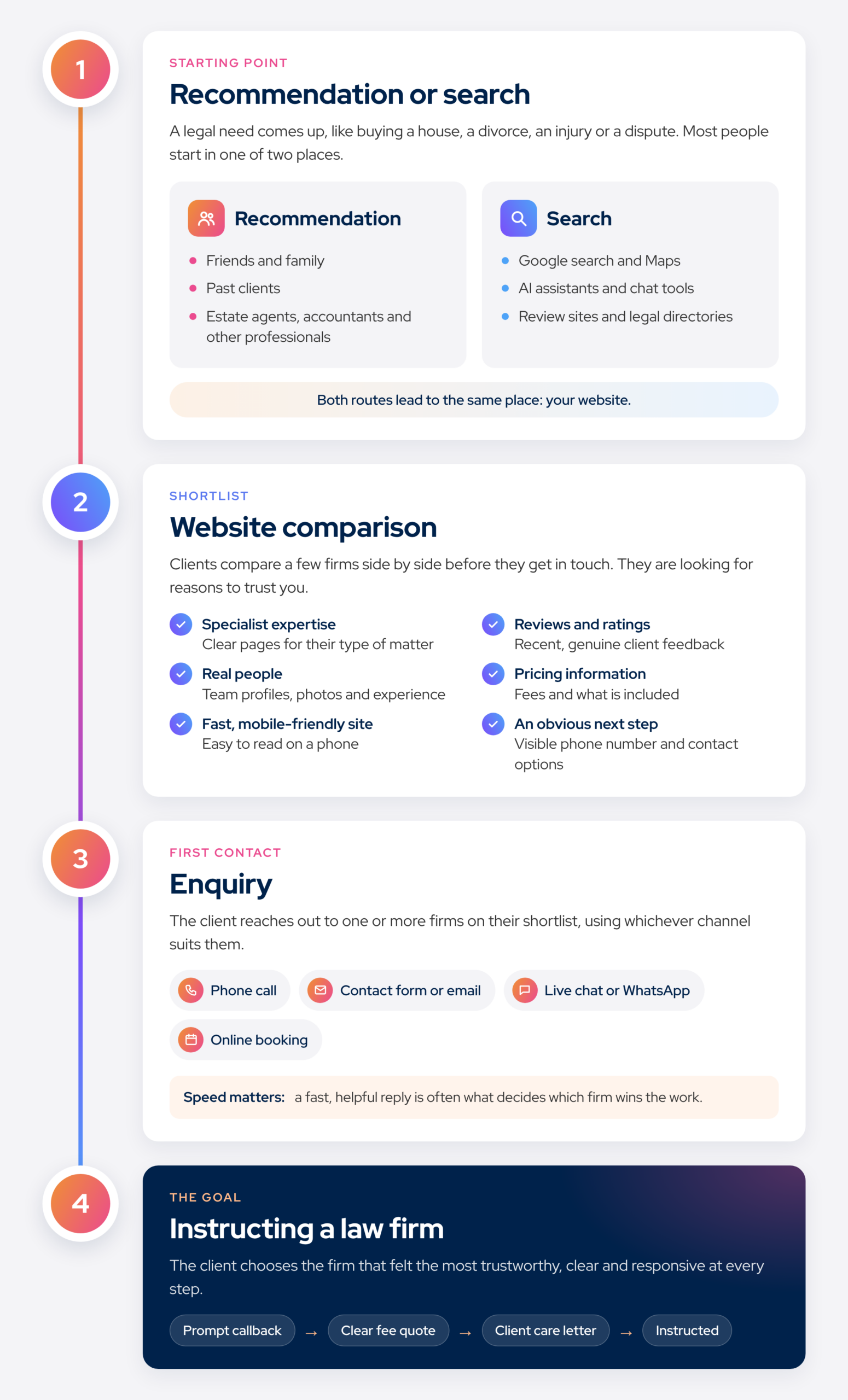
The Legal Services Consumer Panel’s annual tracker survey gives a useful picture of how people pick a lawyer. In the 2026 survey of 3,802 people who’d used a legal service in the last two years (Legal Services Consumer Panel):
- 42% shopped around before choosing a provider, and 77% of those compared three or more providers
- personal connections still lead: 21% mainly chose a provider they or their family had used before, and 18% went on a recommendation from family or friends
- 54% of people who were recommended a provider looked for more information about them before getting in touch
- 18% searched online as part of choosing, and for 12% it was the main way they chose
- only 11% first found the price on the provider’s website, while 63% found out by talking to the provider
- among people who shopped around, 69% found it easy to find information on a provider’s expertise and 67% on how long the matter would take
- 76% said positive published reviews would increase their trust in a legal professional
Three things follow. Search and recommendation work together: more than half of people who get your name from someone else check you out before calling, and what they find online either confirms the recommendation or loses you the instruction. Being visible isn’t enough on its own, because people who shop around usually compare at least three firms side by side. And the bar is low. Only one in nine found a price on a firm’s website, and around three in ten shoppers didn’t find it easy to pin down expertise or timescales. A firm that publishes clear details on services, people, prices and timescales has an easy edge.
Building an SEO strategy for solicitors
Start with fee income, not keywords
Before any keyword research, decide which work you want more of. Ask:
- Which practice areas have capacity?
- Which have the best fee per matter and the best conversion rate?
- Where do clients need to be: one town, a region, England and Wales, or overseas?
- Which services must show prices under the SRA Transparency Rules?
A family team already turning work away doesn’t need more divorce traffic. A private client team with spare capacity and high-value estates might be exactly where to start.
Keyword research for solicitors
Group search terms by what the searcher wants to do, not just by volume. Here’s how we sort them.
| Intent | Example searches | Page that should rank | Priority |
| Ready to instruct | ‘divorce solicitor Nottingham’, ‘conveyancing solicitors near me’ | Practice-area and location pages | Highest |
| Comparing | ‘conveyancing fees’, ‘settlement agreement solicitor cost’ | Price pages, service pages, reviews | High |
| Researching | ‘how long does probate take’, ‘can I contest a will’ | Guides and FAQs | Medium: builds authority and feeds AI answers |
| Background | ‘what is a lasting power of attorney’ | Explainers and glossary | Lower: supports internal links |
Keyword tools understate local legal demand, because lots of phrases fall below their reporting thresholds. Don’t drop a town page because a tool says ‘0 searches’. Check Google Search Console for the impressions you’re already getting instead.
Site architecture: practice areas, sub-services and locations
The firms that rank rarely have ten pages. They usually have 100 or more, built so each one answers a specific need. A family law section needs more than a ‘Divorce’ page. It needs pages on financial settlements, child arrangements, prenuptial agreements, cohabitation disputes and non-molestation orders, each linking back up to the main family law page and across to related guides.
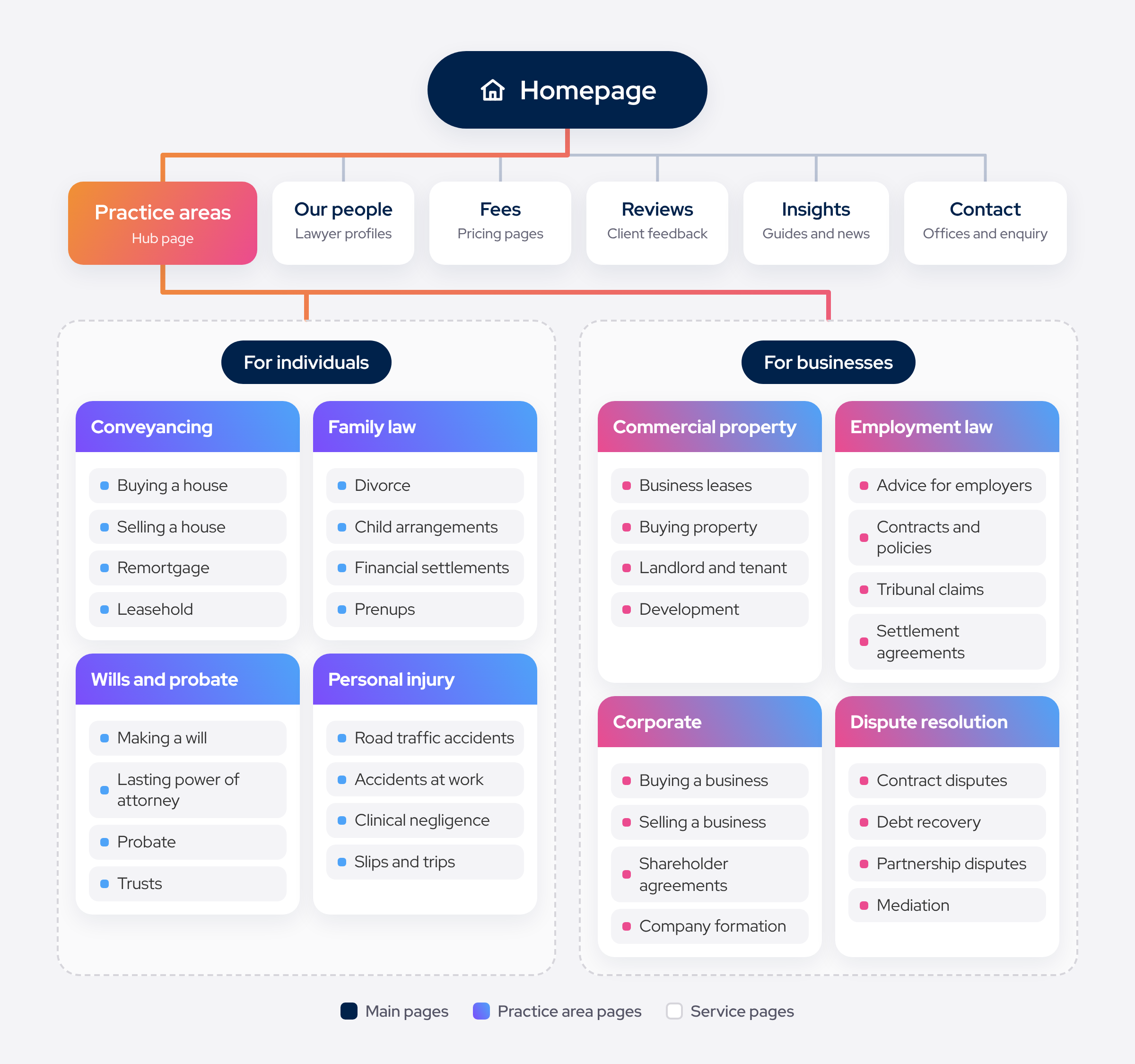
Keep URLs short and readable, such as /family-law/divorce/ rather than /services/page-id-123/. And plan the structure before writing anything, because moving pages later means redirects and lost ground.
On-page SEO for solicitors’ websites
Practice-area pages that turn visits into instructions
Your practice-area pages do most of the commercial work, so they deserve most of the effort. A strong one:
- says in the first two lines what you do, who for and where
- explains the process, likely timescales and costs, or links to your price page
- names the solicitors who’ll handle the matter and links to their profiles
- answers the questions clients ask on the first phone call
- shows proof: reviews, accreditations such as Law Society schemes, and results you’re allowed to share
- makes contact easy on a phone, with a tap-to-call number, a short form and a call-back option
Write for a worried reader with no legal background. Correct terminology matters, but explain it as you go.
Title tags, headings and meta descriptions
Give every page a unique title tag of roughly 50–60 characters with the service and, where it matters, the place: ‘Divorce Solicitors in Nottingham | [Firm name]’. Use one H1 per page, then H2s and H3s that follow the questions people actually ask. Meta descriptions don’t move rankings directly, but they do affect whether someone clicks, so write them like a short advert.
Solicitor profiles and E-E-A-T
Google ‘strongly encourage[s]’ accurate authorship information, such as bylines, wherever readers would expect it (Google Search Central). For a law firm, that means:
- a profile page for every fee earner, covering qualifications, year of admission, specialisms, accreditations and memberships
- bylines or ‘reviewed by’ lines on guides, plus a last-updated date
- an About page that explains who you are, who regulates you and how to complain
People buy people. Someone choosing a solicitor for their divorce wants to see who that solicitor is, and those profiles are a strong trust signal for Google too.
Schema markup
Schema is code that labels your content so search engines understand it. The useful types for law firms are LegalService, Organization, Person (for solicitors), Article (for guides) and BreadcrumbList. Whatever you mark up must match what’s visible on the page.
Two cautions. FAQ rich results now show only for a narrow set of authoritative government and health sites (Google, August 2023) [VERIFY], so FAQ schema is worth adding for clarity but won’t usually earn the dropdowns. And review stars won’t show where a business marks up reviews it controls about itself, which Google calls self-serving reviews (Google Search Central).
Local SEO for solicitors
Search for ‘probate solicitor Derby’ or ‘solicitors near me’ and you’ll usually see a map with three firms above the normal results. Google ranks that map on three things: relevance, distance and prominence. It also says plainly that ‘there’s no way to request or pay for a better local ranking’ (Google Business Profile Help).
Google Business Profile rules law firms get wrong
Your Google Business Profile for solicitors is often the first thing a local client sees. Four rules catch firms out (Google Business Profile guidelines):
- Business name. Use your real-world name only. ‘Smith & Co Solicitors – Divorce Lawyers Leeds’ breaks the rules and risks suspension.
- Virtual offices. An address you rent but don’t operate from isn’t eligible. A serviced ‘office’ in a city you want to rank in won’t do.
- Individual solicitors. Practitioners can have their own profile if they’re public-facing and contactable at the verified location during stated hours. A solo practitioner under a brand should use ‘[brand]: [practitioner name]’. Decide deliberately, because practitioner profiles can compete with the firm’s own.
- Service areas. If you visit clients rather than receive them, set a service area, but keep it within about two hours’ drive of your base.
After that, fill everything in: categories (Google uses some US terms such as ‘attorney’, so pick the closest match), services, hours, photos of real people and premises, and regular posts.
Reviews, and the law on fake reviews
Google says more reviews and positive ratings can help local ranking. The way you collect them is now a legal question as well as a marketing one. Since April 2025, the Digital Markets, Competition and Consumers Act 2024 has banned fake reviews and concealed incentivised reviews, and the CMA’s guidance makes clear businesses shouldn’t invite only happy clients or hide negative reviews (CMA, Fake reviews guidance).
In practice:
- ask every client at the end of a matter, not just the ones you know were pleased
- never write reviews for clients, or offer anything in return without making it clear
- reply to negative reviews calmly and without confirming any client details, since confidentiality still applies (SRA Code, paragraph 6.3)
Location pages
Each office should have its own page with its address, team, directions and the services run from it. For towns you serve without an office, build a page only when you’ve got something real to say about that area. As a rule of thumb, we look for a catchment of around 10,000 people before a dedicated location page is justified, and localised content becomes consistently worthwhile above 15,000. Near-identical pages with the town name swapped are doorway pages, which Google treats as spam (Google spam policies).
Directories and citations
Keep your firm’s name, address and phone number identical everywhere it appears. Priority listings for UK firms are the Law Society’s Find a Solicitor, Bing Places, Apple Business Connect, Yell, relevant review platforms and, for commercial work, the Legal 500 and Chambers and Partners.
Technical SEO for law firm websites
Technical SEO makes sure Google can find, read and trust your pages. Most law firm sites need attention in the same places.
- Crawling and indexing. Check Google Search Console for pages that aren’t indexed, a clean XML sitemap, and a robots.txt that isn’t blocking anything important.
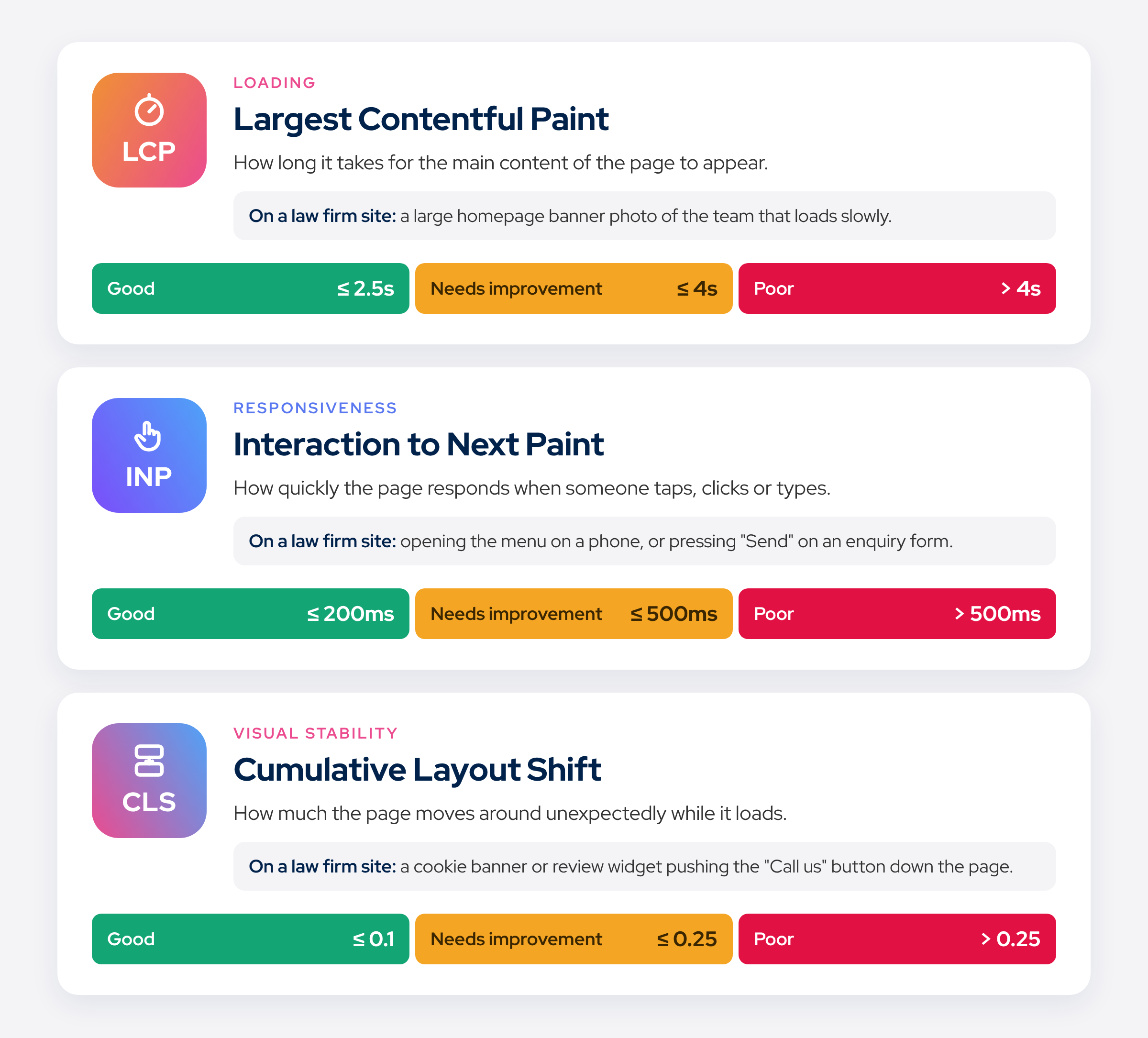
- Core Web Vitals. Google’s page experience measures, with ‘good’ set at a Largest Contentful Paint of 2.5 seconds or less, Interaction to Next Paint of 200 milliseconds or less, and Cumulative Layout Shift of 0.1 or less, measured at the 75th percentile of visits (web.dev). Heavy sliders, chat widgets and unoptimised images are the usual culprits.
- Mobile. Plenty of your visitors will be on a phone, often mid-crisis. Test every practice-area page and form on one.
- Duplicate content. Multi-office firms often copy service pages per location. Use canonical tags or, better, write each page properly.
- Mergers and rebrands. Mergers are one of the most common reasons we see firms lose rankings overnight. Map every old URL to its new home with 301 redirects before the switch.
- The SRA digital badge. You must display it, and it loads through a script. Check it appears on every page template and doesn’t slow the page down.
Content marketing for law firms
Good law firm content marketing answers the questions clients ask before they’re ready to instruct. That might be ‘how long does probate take’, ‘what happens at a first divorce hearing’ or ‘do I need a solicitor for a settlement agreement’. Those pages build authority, earn links, and are exactly what AI tools quote.
What works:
- Guides and FAQs built from real client questions. Ask your fee earners and receptionists what people ring about.
- Legal updates when the law, thresholds or court fees change, with a clear note of what it means for the reader.
- Case studies, anonymised and with client consent.
- Price and process pages, which double as Transparency Rules compliance.
Who writes it matters less than who checks it. A specialist writer can draft, but a named solicitor should review every page for accuracy and sign it off. Google’s spam policies target ‘scaled content abuse’, meaning large volumes of unoriginal pages made mainly to rank (Google spam policies). Mass-produced AI content with no legal review fits that description and carries professional risk as well.
Legal content dates quickly. Set a review cycle, and show a ‘last reviewed’ date on every guide.
Link building and digital PR for law firms
Links from other reputable sites are still one of the clearest signals of prominence. For law firms, the best ones usually come from:
- expert comment for national, regional and trade press
- local law societies, chambers of commerce, charities and sponsorships you’re genuinely involved in
- guest articles in legal and sector trade publications your clients read
- talks, webinars and conference appearances
- original data, such as a survey of local landlords or a review of tribunal outcomes
Avoid paying for links. Google lists ‘exchanging money for links, or posts that contain links’ as link spam (Google spam policies). Ten relevant links from known sites beat hundreds from directories no one reads.
SRA rules and SEO for solicitors
This is the section most SEO guides skip. For a regulated firm, it shapes almost everything else.
Transparency Rules pages are search assets
The SRA Transparency Rules require firms to publish price and service information for set services (SRA). For individuals, they cover:
- residential conveyancing (sales, purchases and mortgages)
- uncontested probate and estate administration
- immigration applications (excluding asylum) and First-tier Tribunal appeals
- motoring offences dealt with in a single Magistrates’ Court hearing
- Employment Tribunal claims for unfair or wrongful dismissal
For businesses, they cover Employment Tribunal defence, debt recovery up to £100,000 and licensing applications for business premises.
You need the total cost (or an average or range), the basis of charges, disbursements, VAT, what’s included, timescales and who’ll do the work. You must also publish your complaints procedure and display the SRA digital badge.
People search for ‘conveyancing fees’ and ‘probate solicitor cost’ constantly. A clear, well-written price page satisfies the regulator and ranks for those searches. A PDF buried in the footer does neither.
Accurate publicity
Paragraph 8.8 of the Code of Conduct requires publicity to be accurate and not misleading, and paragraph 1.4 says you mustn’t mislead clients or others (SRA). The CAP Code also applies to marketing claims on your own website. Watch for:
- ‘best’, ‘leading’ or ‘number one’ claims you can’t evidence
- success rates without a clear basis
- ‘specialist’ used for areas where the team has no particular depth
- ‘no win no fee’ without explaining the deductions that can apply
- case studies or review replies that could identify a client
Legal SEO and AI search
AI Overviews, ChatGPT and Gemini increasingly answer legal questions before anyone clicks. Firms want to know what to do about it, and agencies have been quick to sell ‘GEO’ (generative engine optimisation) as something entirely new.
Google’s position is clear: ‘There are no additional requirements to appear in AI Overviews or AI Mode, nor other special optimizations necessary’ (Google Search Central). The same fundamentals apply. Keep important content in text, link pages together sensibly, give a good page experience, and make sure structured data matches the page.
From our own work, the firms that get cited in AI answers tend to share a few traits:
- clear, direct answers near the top of each page
- named, qualified authors and consistent firm details across the web
- mentions and links from trusted third-party sites
- depth across a practice area, not one page per topic
For one specialist firm, that approach produced 87 AI Overview positions and a 222% month-on-month rise in traffic from ChatGPT. Be careful, though. On another campaign we deliberately held back from over-optimising for AI platforms, because the firm’s existing rankings were too valuable to destabilise. Read more in our guide on how law firms can rank in ChatGPT and Gemini and on our GEO for law firms page.
Measuring SEO for solicitors: from rankings to instructions
Rankings and traffic are early signs. What partners care about is enquiries, instructions and fee income. Track all of it.
| Measure | What it tells you | Where to find it |
| Impressions and clicks by page | Whether Google is showing your pages and people are choosing them | Google Search Console |
| Positions for priority terms | Progress on the searches that matter commercially | A rank tracker |
| Calls, direction requests and website clicks | How your local presence performs | Google Business Profile performance |
| Enquiries by source | Which pages and channels produce leads | GA4 plus call tracking |
| Instructions and fees by source | Whether those leads become paying work | Your case management system |
| Cost per instruction | Whether the spend is paying back | All of the above |
Call tracking matters more for law firms than most sectors, because many clients phone rather than fill in a form. Keep your main number consistent on directory listings, and check that source data flows back into your case management system so you can report on fees, not just enquiries.
Done properly, this is where SEO proves itself. One firm we work with grew its annual online revenue from £250,000 to £2.2 million. A regional firm saw organic enquiries rise 310% over two years. And for a boutique specialist practice, 45% of the department’s new work over 12 months came through the website (case study).
How long does solicitor SEO take?
No honest agency can promise a date, but these are realistic ranges from our experience.
| Starting point | Realistic timescale for meaningful results |
| New site, or limited authority | Around six months |
| Competitive practice areas in major cities | Twelve months or more |
| Recovering from a drop in rankings | Often quicker than building from scratch |
| Local practice area with light competition | Often within 3 months |
Fixes to Google Business Profile and technical problems can show sooner. Content and links compound, so the second year is usually stronger than the first.
How much does SEO for solicitors cost?
Cost depends on how competitive your practice areas and locations are, how much content you need, and the state of your site today. Most firms pay a monthly fee covering strategy, content, technical work and reporting, sometimes after an initial audit.
We quote based on what each firm needs, start with a free initial audit, and work on a rolling monthly basis rather than long contracts. For wider budget benchmarks, see our guide on how much law firms spend on marketing.
SEO vs PPC for solicitors
SEO and pay-per-click (PPC) advertising do different jobs, and the strongest firms use both.
| SEO | PPC (Google Ads) | |
| How you pay | Time, content and agency fees | Every click |
| Speed | Months | Days |
| When spend stops | Rankings fade gradually | Traffic stops straight away |
| Best for | Long-term, cost-effective enquiries; research-stage searches | New firms, new services, urgent matters, testing demand |
| Main risk | Slow to start | Cost per click in competitive areas |
PPC can fill the gap while SEO builds. For one property law firm, our Google Ads campaign produced 33 conveyancing enquiries at an average cost per lead of £52.69 (case study). Search terms that convert well in PPC also tell you which pages to prioritise for SEO. More on our PPC service.
In-house or an SEO agency for solicitors?
Some firms run SEO in-house, especially with a marketing team and a solicitor or two who enjoy writing. That works if someone owns it, has time each week, and can handle the technical side or knows who to call.
A specialist solicitors SEO agency brings sector knowledge, legal writers and tools you’d otherwise pay for separately. Whichever route you choose, watch for these warning signs:
- Guaranteed rankings. No legitimate SEO agency guarantees specific positions.
- Long lock-in contracts before you’ve seen any results.
- Reports full of traffic but nothing on enquiries or instructions.
- Cheap bulk links or vague answers about where links come from.
- No grasp of SRA rules, or content that needs heavy correction by your solicitors.
- The agency owns your accounts. Your firm should own its domain, website, Google Business Profile, Search Console and Analytics.
Ask any agency to explain what they’d do first and why, which practice areas they’d prioritise, and how they’ll report on fee income.
Expert tips from our team
Tip 1: Build out one practice area before spreading thin. A family law section with 25 well-linked pages will usually outperform five practice areas with five pages each. Win one, then move on.
Tip 2: Mine your phone calls. The questions your receptionist hears every day are your best content plan. They’re real, they’re specific, and few competitors answer them properly.
Tip 3: Treat price pages as sales pages. Most Transparency Rules pages are written to tick a box. Explain what’s included, what affects the price and why clients choose you, and they’ll convert as well as rank.
Tip 4: Get solicitors on camera and in print. Short videos and bylined articles from your fee earners give Google and clients the same thing: proof of who’s behind the advice.
Tip 5: You don’t need to upload content all the time. Focus on quality content rather than news jacking. You will never compete with the national media outlets in terms of getting those articles in front of the right people.
Common SEO mistakes solicitors make (and what to do instead)
- One page per practice area. A single ‘Employment law’ page can’t rank for settlement agreements, redundancy, discrimination and tribunal claims at once. Build a page for each service clients search for.
- Copying content across offices. Five location pages with the town name swapped look like doorway pages. Write each one around the team, courts and community it serves.
- Anonymous content. Unsigned guides with no author weaken trust on YMYL topics. Add bylines, profiles and review dates.
- Ignoring Google Business Profile. A half-finished profile with a keyword-stuffed name and no recent reviews is a lost opportunity, or a suspension waiting to happen. Fill it in properly and keep it current.
- Measuring traffic, not instructions. Visits can rise while enquiries fall. Track calls and forms by source, and link them to fee income.
- Redesigning without an SEO plan. New sites and mergers routinely wipe out rankings when old URLs aren’t redirected. Bring SEO in before the designers start.
- Buying cheap links or content. Bulk links and mass-produced articles breach Google’s spam policies and can breach SRA standards on accuracy. Invest in fewer, better pieces.
Frequently asked questions about SEO for solicitors
What is SEO for solicitors?
SEO for solicitors is the process of improving a law firm’s website and online presence so it ranks higher when people search for legal services. It covers the pages on your site, technical health, your Google Business Profile and reviews, and the links and mentions your firm earns elsewhere. The aim isn’t traffic for its own sake. It’s to put your firm in front of people who need a solicitor now, in the areas and locations you want to grow, and then make it easy for them to get in touch. For UK firms, it also has to sit comfortably within SRA rules on publicity and transparency.
Does SEO work for solicitors?
Yes. SEO works well for solicitors because people search for legal help at the exact moment they need it, and the value of each instruction is high. A handful of extra enquiries a month can repay the investment. Results depend on competition, the state of your site and how consistently the work is done. We’ve seen one firm’s online revenue grow from £250,000 to £2.2 million a year, and a regional firm’s organic enquiries rise 310% over two years. It isn’t instant, though, and it works best alongside recommendations, reputation and, where needed, paid search.
How long does SEO take for a law firm?
Expect meaningful results in around six months for a site starting with limited authority, and 12 months or more for competitive practice areas in big cities. Some changes, such as fixing a Google Business Profile or technical errors, can show sooner. Recovering from a ranking drop is often faster than starting from nothing. SEO compounds: content and links built in the first year keep working in the second. Be wary of anyone who promises page one within weeks for terms like ‘personal injury solicitor London’, because that isn’t realistic.
How much does SEO cost for a law firm?
The cost of SEO for solicitors depends on how competitive your practice areas and locations are, how much content you need, and how much technical work your site requires. Most firms pay a monthly fee that covers strategy, content, technical fixes and reporting, often after an initial audit. A local firm focused on one or two practice areas needs less than a national firm competing for high-value terms. Whatever you spend, judge it against cost per instruction, not cost per visit. Marketing Lawyers offers a free initial audit and works on a rolling monthly basis.
Is SEO better than PPC for solicitors?
Neither is better in every case. SEO builds enquiries over time without paying per click, so it’s usually more cost-effective in the long run. PPC delivers enquiries within days and suits new firms, new services or urgent matters, but traffic stops as soon as the budget does. Many firms run both: PPC fills the gap while SEO builds, and PPC search term data shows which pages to prioritise organically. In very competitive areas such as personal injury, click costs can be high, which makes a strong organic presence even more valuable.
Can solicitors do their own SEO?
You can, if someone owns it and has time every week. Solicitors are well placed to write accurate content, and a marketing manager can handle Google Business Profile, reviews and reporting. The harder parts are usually technical SEO, site architecture and link building, which need specialist tools and experience. Plenty of firms take a hybrid approach: an agency sets the strategy and handles technical work, while fee earners contribute or review content. Whatever you choose, make sure the firm owns its website, domain, Google Business Profile and analytics accounts.
What is local SEO for solicitors?
Local SEO for solicitors is the work of ranking in location-based searches, such as ‘family solicitor Leicester’ or ‘solicitors near me’, including the Google map results. It relies on a complete, accurate Google Business Profile, consistent name, address and phone details across directories, genuine client reviews and useful location pages on your site. Google ranks local results on relevance, distance and prominence, and says you can’t pay for a better local position. For most high-street and regional firms, local SEO is where the quickest commercial gains are.
How do I get my law firm into the Google map pack?
Start with a fully completed Google Business Profile at a genuine, staffed address, using your real firm name without added keywords. Choose the closest primary category, add your services, opening hours and real photos, and post updates regularly. Then work on prominence: a steady flow of genuine reviews, consistent directory listings, and links and mentions from local organisations. Make sure your website has a strong page for each office. Distance from the searcher is outside your control, so a firm won’t show in the map pack for every search across a whole city.
Do SRA rules affect SEO for solicitors?
Yes. Your website is publicity under the SRA Code of Conduct, so everything on it must be accurate and not misleading. The SRA Transparency Rules require published price and service information for set services, including residential conveyancing, uncontested probate and some employment and immigration work, along with your complaints procedure and the SRA digital badge. Client confidentiality also applies to case studies and review replies. Handled well, these rules help SEO: clear price pages rank for cost searches, and accurate, author-led content builds trust with Google.
Can we ask clients for Google reviews?
Yes, and you should. Reviews help local rankings and reassure future clients. But since April 2025, the Digital Markets, Competition and Consumers Act 2024 has banned fake reviews and concealed incentivised reviews, and CMA guidance warns against inviting only satisfied clients or suppressing negative ones. The safest approach is to ask every client at the end of their matter, make it easy with a direct link, and never write or edit reviews for them. When you reply, don’t confirm that the reviewer was a client or discuss their matter.
Should law firms use AI to write website content?
AI can help with research, outlines and first drafts, but it shouldn’t publish anything a solicitor hasn’t checked. Google’s concern is quality and purpose rather than how content was produced, though its spam policies target large volumes of unoriginal pages made mainly to rank. For a law firm, there’s a second risk: inaccurate legal content can breach SRA standards and mislead clients. Use AI as a drafting aid, add your own experience and examples, and have a named solicitor review and sign off every page.
How do law firms appear in ChatGPT and AI Overviews?
Google says there are no extra requirements or special optimisations needed to appear in AI Overviews or AI Mode. The same foundations apply: crawlable pages, clear answers in text, good internal linking and accurate structured data. In our experience, firms cited by AI tools also have named expert authors, consistent firm details across the web, mentions on trusted third-party sites and real depth across each practice area. For one specialist firm, this produced 87 AI Overview positions. Don’t chase AI visibility at the expense of rankings you already have.
How many pages does a law firm website need?
There’s no fixed number, but the firms that rank for competitive terms usually have 100 pages or more. The right number comes from your practice areas, the specific services clients search for within each one, your office locations and the questions clients ask. A family law team might need 20 to 30 pages on its own to cover divorce, finances, children, cohabitation and injunctions properly. Every page should earn its place by answering a distinct need. Padding a site with thin or duplicated pages does more harm than good.
How do I choose an SEO agency for solicitors?
Look for an agency with genuine law firm experience, a clear grasp of SRA rules, and results it can explain in terms of enquiries and instructions rather than traffic alone. Ask what they’d do first and why, who writes and reviews the content, where links come from and how they report. Avoid anyone guaranteeing rankings or tying you into a long contract before proving results. Check that your firm keeps ownership of every account. A free audit is a good test of whether they understand your practice areas and market.
Is SEO worth it for a small firm of solicitors?
Yes, and often more so than for a big firm. A sole practitioner or small high-street practice usually competes in one town for a handful of services, and that’s a fight it can win. A complete Google Business Profile, a steady flow of genuine reviews and a strong page for each service you want more of will do most of the work. You don’t need hundreds of pages or a national budget. Focus on the searches where you can genuinely help, keep your content accurate and make it easy for local clients to call.
Glossary of SEO terms for solicitors
| Term | Definition |
| AI Overview | Google’s AI-generated summary shown above some search results, with links to sources |
| Backlink | A link from another website to yours, treated by Google as a signal of trust |
| Canonical tag | Code telling search engines which version of a page is the main one |
| Core Web Vitals | Google’s measures of loading speed, responsiveness and visual stability |
| E-E-A-T | Experience, expertise, authoritativeness and trust: the qualities Google looks for in content |
| GEO | Generative engine optimisation: improving visibility in AI search tools |
| Google Business Profile | Your free listing on Google Search and Maps |
| Local pack | The map and three business listings shown for local searches |
| Meta description | The short summary that can appear under your page title in search results |
| Organic search | Unpaid search results, as opposed to ads |
| Schema markup | Structured data code that labels page content for search engines |
| Search Console | Google’s free tool showing how your site performs in search |
| Transparency Rules | SRA rules requiring firms to publish price, service and complaints information |
| YMYL | ‘Your Money or Your Life’: topics that can significantly affect people’s health, finances or safety |
Related resources
- SEO for solicitors: our service
- GEO for law firms
- How law firms can rank in ChatGPT and Gemini
- Case study: SEO-driven lead generation for a specialist practice
- How much do law firms spend on marketing?
- Law firm website design
About the author
Jon Budge, Head of Digital Marketing & Client Strategy, Marketing Lawyers
Jon has more than 15 years’ experience in digital marketing, much of it in-house at UK law firms including Irwin Mitchell, Hugh James and Healys LLP. He’s led SEO, PPC, content and brand strategy across as many as 16 practice areas at once, and knows the compliance side inside out: SRA rules, GDPR, E-E-A-T and YMYL standards. One multichannel campaign he ran produced £1.8m in fees against a £1m target, and his work won Marketing Campaign of the Year at the Personal Injury Awards 2022.
Get a free SEO audit for your firm
We’ve worked only with law firms since 2018, and more than 100 firms trust us with their marketing. We already know your sector, your regulator and your clients, so we don’t spend your budget learning them. Our free audit shows where your site stands, which practice areas offer the quickest wins, and what we’d do first. No long contracts, no ranking guarantees, just an honest plan.
Call 0330 133 8783, email info@marketinglawyers.co.uk or book a call.
Not ready yet? Read our guide on ranking in ChatGPT and Gemini.
Disclaimer
This guide is general information about marketing and search engine optimisation for law firms. It isn’t legal or regulatory advice. Firms remain responsible for making sure their websites and marketing comply with the SRA Standards and Regulations, the CAP Code and consumer protection law. If you’re unsure, speak to your COLP or contact the SRA’s Professional Ethics helpline. Results described are from specific client campaigns and aren’t a guarantee of future performance.